


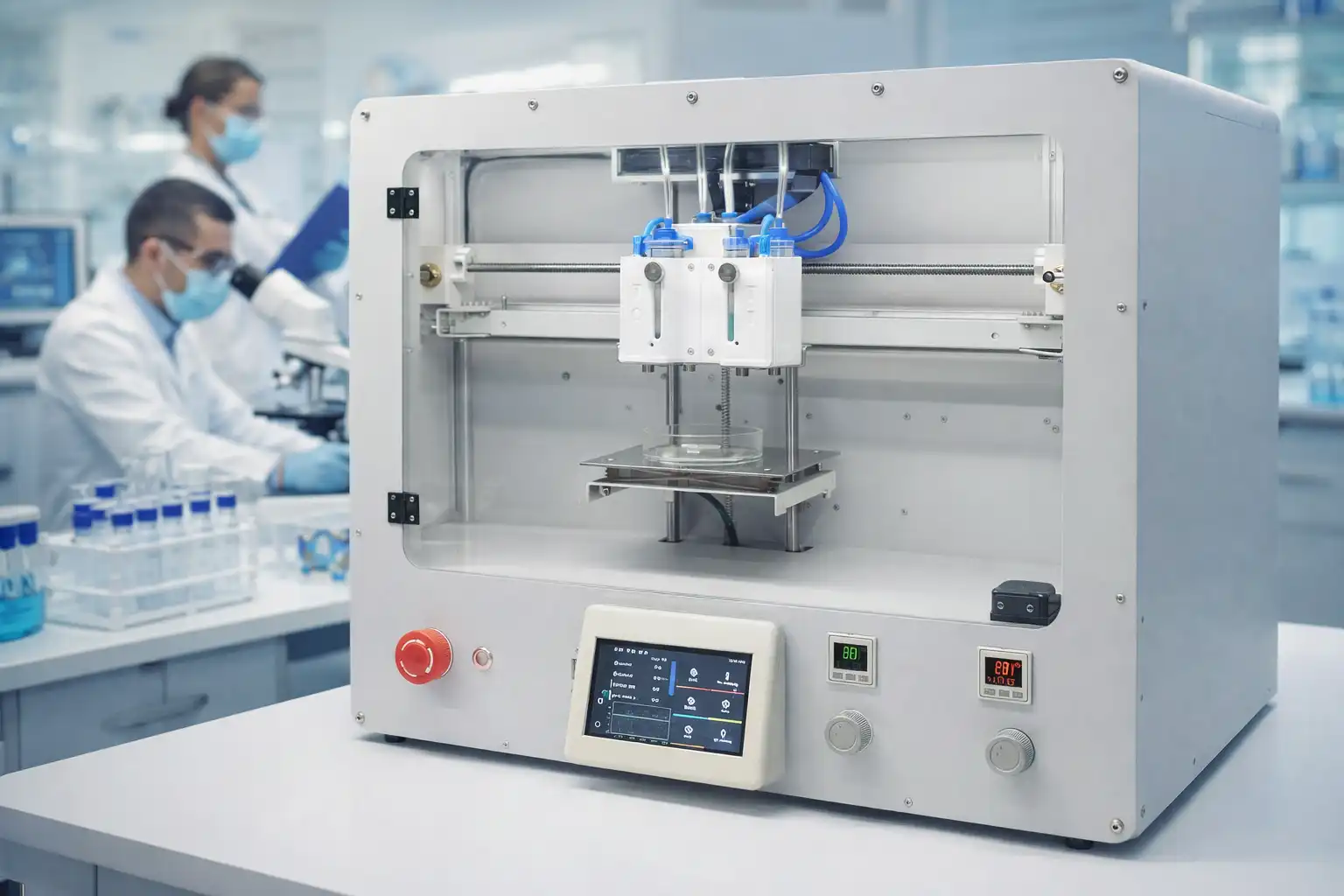
The Garuda 3D Bio PRO is the professional flagship of India's most comprehensive bio 3D printing range. With a dual-head pneumatic extrusion system, independent pressure control up to 8 bar, HEPA H14 clean air filtration (99.995% efficiency), an integrated UV sterilisation chamber, coaxial nozzle capability, and syringe temperatures from 4°C to 250°C — the Bio PRO is the most capable bioprinting platform available from an Indian manufacturer.
India's Professional-Grade Bio 3D Printer — Built for Serious Research
Bioprinting research has tiers. At the entry level, basic syringe extrusion platforms let researchers print thermoresponsive hydrogels and explore bioprinting fundamentals. At the intermediate level, UV curing and pressure monitoring extend capability to photocurable bioinks and data-driven process control. But at the professional level — where live-cell bioprinting, multi-material tissue constructs, vascular channel fabrication, and true aseptic operation are required — an entirely different class of instrument is needed.
That class is the Garuda 3D Bio PRO. It is a fully enclosed, pneumatically driven, sterility-controlled bioprinting platform combining two independently controlled print heads, precision pressure regulation at 0.01 bar resolution, HEPA H14 air filtration removing 99.995% of particles, a built-in UV sterilisation chamber, coaxial nozzle capability for hollow vascular constructs, and per-head temperature control spanning 4°C to 250°C.
Six Hardware Capabilities That Define Professional Bioprinting
The Bio PRO integrates six engineering capabilities that collectively set it apart from every other bioprinting platform in its class available in India.
Dual-Head Pneumatic Extrusion
Two independently controlled pneumatic bio-heads (up to 8 bar, 0.01 bar resolution) enable simultaneous multi-material bioprinting — scaffold, cell-laden bioink, and sacrificial polymer in a single construct.
4°C to 250°C per Head
Each bio-head independently regulates syringe temperature — from 4°C for cell-sensitive collagen and Matrigel to 250°C for thermoplastic bio-composites. Rapid cooling reaches 4°C in under 5 minutes.
Coaxial Nozzle Capability
Concentric nozzles deposit two materials simultaneously in core-shell configuration, enabling hollow vascular channels, cell-encapsulation microcapsules, and multi-layer construct fabrication.
HEPA H14 Filtration
Removes 99.995% of airborne particles and microorganisms from the enclosed print chamber — near biosafety cabinet performance for cell-laden bioprinting without a separate laminar flow hood.
UV Sterilisation + Multi-Wavelength Curing
Integrated UV chamber sterilises the print environment pre-session. Swappable 365/395/405 nm UV curing modules support the full range of photocurable bioinks (LAP, Irgacure 2959, Ru/SPS systems).
5" Touchscreen + Web UI + Wi-Fi
Control via touchscreen, USB, SD card, Ethernet, or Wi-Fi web interface. Cura, Custom Slicer, and RepRap compatible. STL, OBJ, 3MF, GCODE on Windows, macOS, and Linux.
Dual-Head Pneumatic Extrusion: Why It Changes Everything
Pneumatic extrusion — using controlled air pressure to drive material from the syringe, rather than a mechanical lead screw — is the industry standard for professional bioprinters. It delivers gentler, more consistent material flow (reducing shear stress on cells), enables independent control of each head (true multi-material printing), and handles a wider viscosity range from ultra-low-viscosity cell suspensions to thick collagen pastes that would stall electromechanical systems.
The Bio PRO's two bio-heads operate with independent pressure control at 0.01 bar resolution. Each head is individually tuned to the extrusion characteristics of its loaded bioink. Head 1 may print a GelMA scaffold at 1.5 bar while Head 2 simultaneously deposits cell-laden alginate at 0.8 bar.

- Two heads with independent pressure control (up to 8 bar, 0.01 bar resolution) for precise, material-specific extrusion
- Simultaneous multi-material printing — structural scaffold, cell-laden bioink, and sacrificial polymer in one construct
- Compatible with 3 mL, 5 mL, and 10 mL BD syringes with Luer-lock tips across all two heads
- Independent temperature regulation per head (4°C to 250°C) — each material at its optimal printing temperature simultaneously
- Print speed up to 30 mm/s; print precision 0.01 to 0.2 mm (nozzle and material dependent)
HEPA H14 + UV Sterilisation: Aseptic Bioprinting Built In
For cell-laden bioprinting — where living cells are encapsulated within the bioink and must remain viable throughout the print — the print environment is as important as the bioink itself. Airborne contamination poses a constant risk to cell viability and construct sterility. Professional bioprinters must incorporate environmental controls that go far beyond what an open-frame platform can offer.
The Bio PRO is an enclosed machine with two layers of sterility assurance. First, the HEPA H14 filtration system continuously removes 99.995% of airborne particles and microorganisms from the print chamber — the same filtration class used in pharmaceutical manufacturing and hospital operating theatres. Second, the integrated UV sterilisation chamber decontaminates the entire print enclosure before each session, eliminating surface contamination accumulated between runs.
HEPA H14 in Practice
HEPA H14 removes 99.995% or more of particles 0.3 microns and above — including bacteria, fungal spores, and most airborne viruses. Combined with UV sterilisation, the Bio PRO's print environment approaches biosafety cabinet Class II performance. For many cell-laden bioprinting workflows, this eliminates the need to position the printer inside a laminar flow hood — a significant operational advantage in labs where BSC space is limited.
Coaxial Bioprinting: Hollow Vascular Channels and Core-Shell Constructs
Coaxial bioprinting is one of the most important technical advances in biofabrication. Using a concentric nozzle assembly — an inner needle within an outer barrel — the Bio PRO deposits two materials simultaneously in core-shell configuration. This enables constructs with internal architecture that a single-nozzle printer cannot achieve: hollow tubular channels, encapsulation microspheres, and multi-layer constructs with spatially controlled composition.
The most impactful application is vascular channel fabrication: a sacrificial or ionic-crosslinkable core material is deposited simultaneously with a structural shell. After printing, the core is removed by dissolution or temperature change, yielding a continuous hollow lumen that can be perfused — mimicking blood vessels, bile ducts, and lymphatic channels for research and regenerative medicine applications.
Core-Shell Configurations
Alginate shell with CaCl2 crosslinker core enables immediate ionic crosslinking during extrusion. GelMA shell with Pluronic sacrificial core allows UV curing of the shell followed by cold dissolution of the core, recovering a hollow vascular channel. Cell-laden core within an alginate or collagen protective shell enables cell encapsulation with a structural coating. Each configuration is achievable on the Bio PRO's coaxial system in a single print operation.
- Hollow vascular channel fabrication — perfusable tubular constructs for vascular tissue engineering and organ model development
- Core-shell microcapsule fabrication for cell encapsulation and controlled therapeutic delivery research
- Simultaneous crosslinking during extrusion — ionic crosslinking of alginate shell triggered by CaCl2 in the flowing core
- Multi-material gradient constructs with spatially varying composition within a single extruded filament
- Cell-laden bioinks with protective structural outer coatings to reduce nozzle shear-induced cell death
4°C to 250°C: The Widest Temperature Range in Academic Bioprinting
Biomaterial behaviour in bioprinting is fundamentally temperature-dependent. Gelatin gels below 25°C and liquefies above it. Native collagen must be kept cold to prevent premature fibril formation. Cell-laden bioinks need refrigeration to minimise metabolic stress. GelMA requires mild warming for optimal extrusion viscosity. PCL and thermoplastic bio-composites need temperatures above 60°C to flow at printable viscosities.
The Bio PRO's independent per-head temperature control (4°C to 250°C) makes all of these materials printable — simultaneously if needed. Head 1 at 4°C for a cell-laden collagen bioink, Head 2 at 37°C for GelMA. This range and per-head independence simply does not exist in any other Indian bioprinting platform.
For cell-laden bioinks, maintain syringe temperature at 4 to 8°C during loading and printing to maximise post-print cell viability. The Bio PRO's rapid cooling capability (4°C in under 5 minutes) is specifically engineered for this protocol — a feature absent in both the Bio-Atom and Bio-Morph.
Bio PRO Complete Technical Specifications
Full specifications of the Garuda 3D Bio PRO as currently manufactured and supplied from Hyderabad, India.
| General Properties | Specification |
|---|---|
| Print Technology | Pneumatic 2-head system, independent pressure control (up to 8 bar, 0.01 bar resolution) |
| Build Volume | 130 x 100 x 75 mm |
| Number of Heads | 2 independent bio-heads |
| Syringe Compatibility | 3 mL, 5 mL, 10 mL BD-compatible with Luer-lock |
| Print Platform | Petri dish (35 to 80 mm), 6/12/24/48/96-well plates, glass slides, confocal dish |
| Print Speed | Up to 30 mm/s (material-dependent) |
| Print Precision | 0.01 to 0.2 mm (nozzle and material dependent) |
| XYZ Axis Precision | 10 microns or less (linear guide rails, lead screw transmission) |
| Display | 5" HDMI touchscreen |
| Architecture | Enclosed machine with integrated UV sterilisation chamber |
| Photo-Crosslinking | Swappable 365 / 395 / 405 nm UV curing modules |
| Clean Air | HEPA H14 filtration (99.995% particle removal efficiency) |
| Build Plate Levelling | Manual |
| Warranty | 12 months standard + extended support plans available |
| Temperature and Mechanics | Specification |
|---|---|
| Syringe Temperature | 4°C to 250°C (independent per head) |
| Rapid Cooling | Reaches 4°C in under 5 minutes |
| Heating Bed | Room temperature to 80°C |
| Mechanics | Linear guide rails, lead screw transmission |
| Software and Connectivity | Specification |
|---|---|
| Slicing Software | Cura, Custom Slicer, RepRap |
| File Formats | .STL, .OBJ, .3MF, .GCODE |
| OS Compatibility | Windows, macOS, Linux |
| Connectivity | USB, SD card, Ethernet, Wi-Fi (Web-UI) |
| Power | 240V AC, 50Hz |
Research Applications of the Garuda 3D Bio PRO
The Bio PRO's dual-head capability, environmental sterility control, coaxial nozzle system, and extreme temperature range enable the full spectrum of advanced bioprinting research — from fundamental tissue engineering to clinical translation-focused regenerative medicine.
Garuda 3D Bioprinting Range: Which Platform is Right for Your Lab?
Garuda 3D offers three bio 3D printers positioned for different research contexts and capability requirements. The table below makes the choice straightforward.
| Capability | Bio-Atom | Bio-Morph | Bio PRO ★ |
|---|---|---|---|
| Extrusion Type | Electromechanical (1 head) | Advanced electromech. (1 head) | Pneumatic (2 heads, 8 bar) |
| Number of Heads | 1 | 1 | 2 independent |
| UV Curing | Not included | Integrated | Swappable 365/395/405 nm |
| Pressure Monitoring | Not included | Real-time | 0.01 bar resolution per head |
| HEPA Filtration | Not included | Not included | HEPA H14 (99.995%) |
| UV Sterilisation Chamber | Not included | Not included | Integrated UV chamber |
| Coaxial Nozzle | Not available | Not available | Core-shell bioprinting |
| Syringe Temperature | Not regulated | Limited | 4°C to 250°C per head |
| Dual-Material (Single Print) | Not possible | Not possible | Up to 2 materials simultaneously |
| Cell-Laden Bioprinting | Basic | Intermediate | Professional (HEPA + cold control) |
| Target User | Entry-level academic labs | Advanced academic research | R&D labs, hospitals, pharma, ICMR |
⭐ When to Choose the Bio PRO
If your research requires live-cell bioprinting, simultaneous multi-material constructs, coaxial vascular channel fabrication, aseptic operation without a dedicated biosafety cabinet for printing, thermoplastic bio-composite printing, or any combination of these — the Bio PRO is the only platform in Garuda 3D's range that meets all these requirements together.
End-to-End Support: Installation, Training, and Ongoing Maintenance
Every Bio PRO is supplied with Garuda 3D's comprehensive support programme — recognising that professional bioprinting equipment requires more than a delivery and a user manual.
-
1On-Site Installation and Calibration
Garuda 3D engineers visit your lab to commission the Bio PRO — mechanical calibration, pneumatic system checks, HEPA filter verification, UV module testing, and first-print validation on your specific biomaterial.
-
2Hardware, Software and Bioink Protocol Training
Remote or in-person sessions covering the full Bio PRO workflow: G-code preparation, pressure and temperature optimisation per bioink, multi-head programming, UV sterilisation protocols, and HEPA maintenance procedures.
-
3Preventive Maintenance Programme
Scheduled HEPA filter replacements, nozzle and coaxial nozzle cleaning, pneumatic system checks, firmware updates, and UV module performance verification — keeping the Bio PRO operating at specification.
-
424/7 Priority Troubleshooting
Direct access to Garuda 3D engineers via live chat and email. Priority response for Bio PRO customers — critical issues addressed within hours, not days.
-
5Annual Maintenance and Extended Warranty Options
Annual plans covering optional upgrades, spare parts kits (nozzles, HEPA filters, UV modules), discounted servicing, and extended warranty beyond the standard 12-month coverage.
-
6Dedicated Support Portal
Access to Garuda 3D's online portal — video tutorials, G-code templates, biomaterial compatibility databases, troubleshooting guides, and a bioink parameter library that grows with every customer installation.
FAQs: Garuda 3D Bio PRO Bio 3D Printer
The Bio PRO: Professional Bioprinting, Made in India
From dual-head pneumatic extrusion to HEPA H14 filtration, UV sterilisation, and coaxial vascular printing — the Garuda 3D Bio PRO brings professional-grade bioprinting to Indian research institutions at a price point international competitors cannot match. Request a demo, quotation, or on-site consultation today.
Request a Demo or Quote