

Keerthika Technologies,
2-39/1/B, Beside DENA
Bank, Gowthami Nagar,
Chandanagar, Hyderabad,
India - 500050
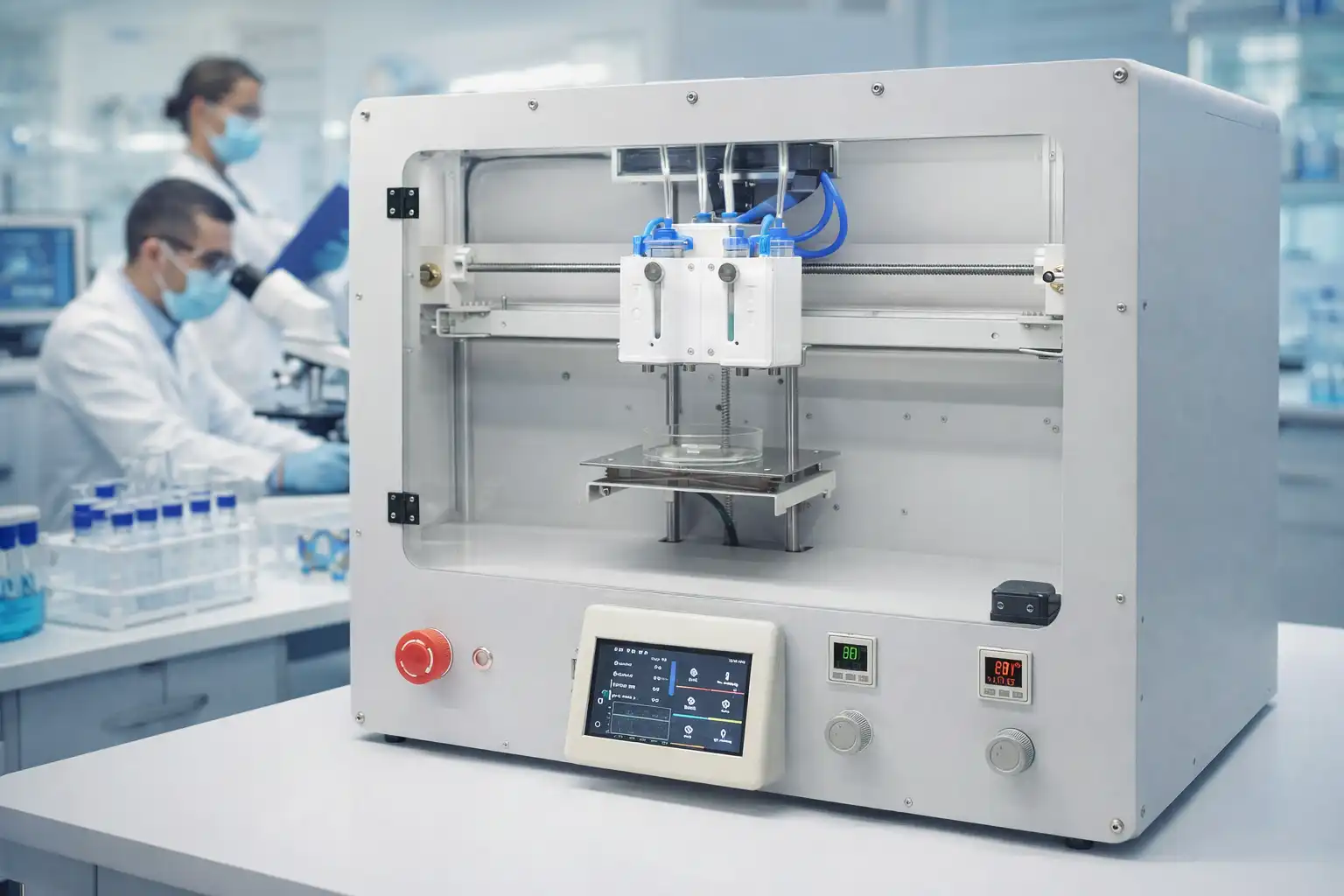
Garuda3D’s flagship bioprinting platform engineered for advanced tissue engineering, drug-discovery workflows, and controlled research environments. The Bio PRO combines temperature-controlled dual-heads, pneumatic extrusion, a HEPA-filtered enclosed chamber, and a touchscreen control interface for flexible, research-focused biofabrication.
The Bio PRO is Garuda3D's advanced research bioprinting platform for tissue engineering, drug testing, and biomaterial workflow development. It combines independent temperature-controlled heads, pneumatic extrusion, and an enclosed operating environment for controlled lab-based biofabrication.
The Bio PRO features two independent temperature-controlled Bio-Heads that enable simultaneous multi-material deposition with precise thermal management per head. A pneumatic extrusion system supports reproducible flow for high-viscosity and cell-laden formulations used in academic and industrial research workflows.
The HEPA-filtered enclosure supports controlled print conditions for research environments, while the integrated touchscreen interface provides on-device control and real-time parameter monitoring throughout each print run.
Each Bio-Head on the Bio PRO is independently heated, allowing researchers to set and maintain different extrusion temperatures per syringe simultaneously. This is essential when printing multi-material constructs where each bioink has a distinct thermoresponsive gelation point.
The heated bed (up to 80°C) provides substrate temperature management critical for maintaining construct adhesion and for thermoresponsive bioink handling during deposition. Combined with the heated nozzle, every thermal variable in the extrusion chain is under active control.
Temperature control directly enables work with gelatin, collagen, and agarose — materials that must be extruded above their gel transition temperature — without thermal crosstalk between heads.
37°C — Thermoresponsive hydrogel extrusion
22°C — Room temperature ionic crosslinking
The Bio PRO's pneumatic extrusion system drives syringe plungers using precisely regulated compressed air pressure rather than relying solely on mechanical stepper motors. This fundamental difference in extrusion mechanism produces smoother, more consistent material flow — particularly for high-viscosity and cell-laden bioinks where stepper-induced pressure spikes can damage fragile cell membranes.
Pneumatic pressure is precisely and continuously adjustable, enabling researchers to dial in exact flow rates for each material without modifying physical tip configurations. Combined with the integrated pressure monitoring system, the Bio PRO provides complete closed-loop awareness of extrusion conditions throughout each print run.
This system is particularly important for living cell bioinks — where minimising mechanical shear forces during extrusion is critical to maintaining high post-print cell viability.
Cell Viability Advantage: Pneumatic extrusion reduces shear-induced cell death by eliminating the mechanical pulsing associated with stepper-driven lead screw systems, resulting in higher viable cell counts in printed constructs.
Compressed air delivers steady, pulse-free pressure to syringe plungers – producing smooth extrusion ribbons with no mechanical stepping artefacts.
Fine-tune extrusion pressure in real time without tool changes – adapt instantly to different bioink viscosities during a single print session.
Lower mechanical stress on cells during extrusion preserves membrane integrity – validated to improve post-print cell viability in encapsulated bioinks.
Pneumatic pressure generation handles high-viscosity materials that exceed the force capacity of standard stepper-driven mechanical extruders.
The Bio PRO's fully enclosed print chamber is equipped with HEPA filtration and UV sterilisation, creating a controlled, aseptic environment directly within the printer. This eliminates the constraint of operating inside an external biosafety cabinet, enabling direct bioprinting with live primary cells and tissue constructs.
Researchers can pre-sterilise the chamber between print runs using the integrated UV-C decontamination cycle, maintaining consistent biosafety standards without the downtime associated with external cabinet sterilisation workflows.
Removes 99.995% of particles and microorganisms from the chamber environment, providing a clean-room equivalent print atmosphere.
Pre-print UV-C decontamination cycle eliminates residual contamination from chamber surfaces, tools, and substrate materials
Full enclosure prevents external contamination from entering the print environment during long-duration live-cell bioprinting runs.
The self-contained sterile environment removes the dependency on external biosafety hoods — simplifying lab workflow and reducing operational footprint.
The Bio PRO’s thermal control, pneumatic extrusion, and enclosed chamber support a wide range of research bioinks — from thermoresponsive hydrogels and photopolymerisable scaffolds to cell-laden formulations that require controlled, low-variance deposition conditions.
Materials marked UV Curable are enabled by the on-board UV curing module. Materials marked Live Cell / Sterile are best suited to controlled research settings using the Bio PRO’s HEPA-filtered chamber and clean workflow practices.
The pneumatic extrusion system particularly benefits high-viscosity and cell-laden inks, where mechanical drive systems may impose greater shear stress on sensitive formulations. Pneumatic pressure can be adjusted per head to match the specific rheology of each material.
Materials marked UV Curable are enabled by on-board UV curing. Materials marked Live Cell / Sterile Required are intended for controlled laboratory use with the HEPA-filtered enclosure.
Research-Ready: The Bio PRO is designed to support controlled live-cell and tissue research workflows in a HEPA-filtered enclosure, with user-specific validation and lab SOPs remaining the responsibility of the operating facility.
Technical Data
Ideal starting point for academic labs and early-stage research. Reliable extrusion-based bioprinting with essential capabilities.
Enhanced research platform with UV curing and pressure monitoring for higher precision, control, and material capability.


