Garuda3D Logo

Follow on Social Media

3D PRINTING TRAINING

Industry-Oriented Additive Manufacturing Certification

ABOUT THE COURSE

The Advanced 3D Printing & Additive Manufacturing Program is a hands-on, industry-focused certification designed to build complete additive manufacturing professionals not just machine operators.

Participants gain practical expertise in:

  • FDM / FFF
  • IDEX systems
  • CoreXY architecture
  • LFS overview
  • Pellet extrusion basics
  • Food-grade and bio-printing exposure (if included)

The program also includes exposure to Klipper firmware, calibration methodologies, structured failure analysis, and mechanical assembly insights setting it apart from conventional college programs.
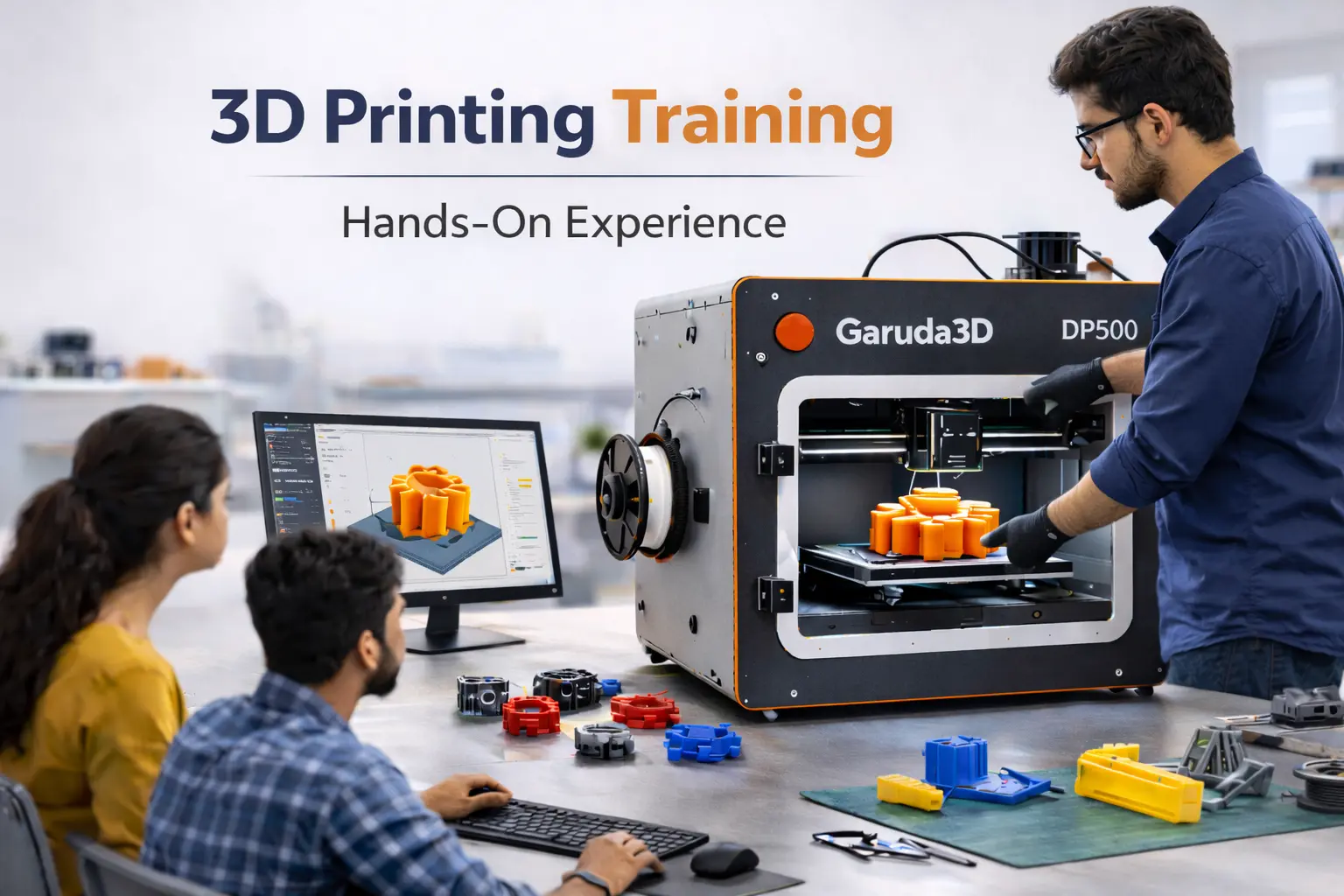
Garuda3D Academy 3D printing training lab Hyderabad India — hands-on additive manufacturing education facility

WHY THIS PROGRAM IS DIFFERENT

Most training programs teach only software and basic printing.

01

Real machine architecture and motion systems

02

CoreXY, IDEX and advanced kinematics

03

Firmware configuration and calibration

04

Failure diagnostics and print troubleshooting

05

Industrial materials and application-driven printing

06

Production workflow and cost analysis

You don’t just operate printers. You understand how they work, how to optimize them, and how to use them in real manufacturing scenarios.

COURSE OVERVIEW

Key Highlights of the Training Program

Technical Session on Additive Manufacturing

Comprehensive introduction to Additive Manufacturing principles, including AM workflow, ASTM/ISO standards, and the seven core AM technologies used in modern industry.

Different Types of 3D Printing Materials

In-depth understanding of polymers, engineering-grade materials, composites, and high-performance thermoplastics like ABS, ASA, PA-CF, PC, TPU, PP, and PPS.

Detailed Explanation on FDM and LFS Technologies

Deep dive into FDM/FFF processes and Vat Photopolymerization (SLA/DLP/LFS), covering machine architecture, parameter optimization, and industrial applications.

Install & Learn Slicing Software to Generate G-Code

Hands-on training with Cura and Simplify3D. Learn to generate optimized G-code and fine-tune prints for speed, strength, and precision.

Case Studies and Practical Sessions

Real-world industry case studies across automotive, aerospace, medical, and IoT sectors including live machine calibration and troubleshooting.

3D Design Approach (DfAM)

Learn topology optimization, lattice structures, generative design, build orientation strategies, and efficient production planning.

PROGRAM STRUCTURE

Week 1: AM Foundations
  • Components & processes of AM
  • Seven AM technologies overview
  • ASTM/ISO standards & terminology
  • AM maturity models & industry applications
  • Introduction to FDM/FFF, SLA/DLP, SLS/MJF
Week 2: Materials & Core Technologies
  • Polymers, metals, ceramics, composites
  • Material selection strategies
  • ABS, ASA, PA+CF, PC, TPU, PP, PPS
  • Thermal & chemical resistance
  • Post-processing methods
Week 3: DfAM
  • Topology optimization
  • Lattice structures
  • Generative design
  • Build orientation strategy
  • Slicing software introduction
Week 4: Production & Final Project
  • Advanced slicing
  • Machine calibration
  • Serial production basics
  • Cost analysis
  • Final Mini Capstone Project
Week 1: Additive Manufacturing Foundations
  • Introduction to Additive Manufacturing
  • AM workflow & terminology
  • ASTM/ISO standards overview
  • Industry applications & case examples
Week 2: FDM/FFF Technology Deep Dive
  • Machine architecture
  • Motion systems & extrusion systems
  • Print parameters & optimization
  • Common defects & troubleshooting
Week 3: SLA / DLP / LFS Technology
  • Vat photopolymerization principles
  • Resin types & material properties
  • Support strategy & orientation
  • Post-processing workflow
Week 4: Materials Engineering
  • Engineering polymers (ABS, ASA, PC, PA-CF, TPU)
  • Shrinkage & warping analysis
  • Thermal & mechanical properties
  • Material selection strategy
Week 5: Design for Additive Manufacturing (DfAM)
  • Topology optimization
  • Lattice structures
  • Generative design basics
  • Build orientation strategy
Week 6: Advanced Slicing & Process Control
  • Cura & Simplify3D advanced settings
  • Custom profile creation
  • Speed vs strength optimization
  • G-code analysis & tuning
Week 7: Production & Quality Control
  • Serial production workflow
  • Quality inspection methods
  • Surface finishing techniques
  • Risk & safety management
Week 8: Industry Implementation & Capstone
  • ROI modeling & cost analysis
  • Industrial case study evaluation
  • End-to-end AM project execution
  • Final Capstone Presentation
Week 1-2: Additive Manufacturing Foundations
  • Components and processes of additive manufacturing
  • Seven AM technologies overview (Material Extrusion, Powder Bed Fusion, Vat Photopolymerization, Material Jetting, Binder Jetting, Directed Energy Deposition, Sheet Lamination)
  • ASTM/ISO standards and terminology
  • AM maturity models and industry applications
Week 3-4: Core AM Technologies & Materials
  • FDM/FFF technology deep dive
  • SLA/DLP vat photopolymerization processes
  • SLS/MJF powder bed fusion
  • Material properties: Polymers, metals, ceramics, composites
  • Material selection criteria for applications
Week 5-6: Design for Additive Manufacturing (DfAM)
  • Design optimization techniques
  • Topology optimization fundamentals
  • Lattice structures and generative design
  • Build orientation strategies
  • Support structure management
  • Design constraints and build limitations
Week 7-8: Advanced Slicing & Machine Management
  • Advanced slicing with professional software (Simplify3D, Cura)
  • Creating custom print profiles through stress testing
  • Precision, speed, and robustness optimization
  • Multi-material and dual extrusion printing
  • Large-scale print strategies
  • Advanced machine calibration and maintenance
Week 9-10: Materials Mastery & Post-Processing
  • Technical materials (ABS, ASA, HIPS, PA+Carbon, PC, TPU, PP, PPS)
  • Thermal and chemical resistance considerations
  • Material shrinkage management
  • Post-processing techniques (mechanical, chemical, thermal)
  • Surface finishing and treatment
  • Quality control and inspection methods
Week 11-12: Production Implementation & Certification
  • Serial production techniques
  • AM workflow and digital thread management
  • Safety protocols and risk management
  • Quality assurance and testing (NDT methods)
  • Production acceptance testing
  • Cost analysis and business case development
  • Industry-specific applications (Automotive, Aerospace, Medical, IoT)
  • Final project: End-to-end production workflow

Hands-On Lab Exposure

Participants work directly with:

  • Desktop FDM systems
  • IDEX systems
  • Industrial-scale builds
  • Multi-material setups
  • Real customer application parts

You will learn not only how to print, but how to diagnose failures, improve quality, and optimize productivity.

Industrial Case Studies

Training includes practical exposure to:

  • Functional prototypes
  • End-use components
  • Tooling applications
  • Jigs and fixtures
  • Custom manufacturing use cases

Certification

Participants receive:

  • Garuda3D Industry-Oriented Additive Manufacturing Certification

Certification is awarded upon successful completion of:

  • Module assessments
  • Practical evaluation
  • Capstone project review

WHO SHOULD ATTEND

Mechanical and manufacturing engineers

Product designers and CAD professionals

Entrepreneurs starting a 3D printing business

R&D professionals exploring AM integration

Engineering students seeking industry exposure

Professionals planning a career shift into Additive Manufacturing

CAREER PATHWAYS

This training prepares participants for roles such as:

3D Printing Technician
Additive Manufacturing Engineer
Rapid Prototyping Specialist
Product Design Engineer
Materials & Process Engineer
Print Farm Manager
AM Consultant

For entrepreneurs, the program provides practical clarity on starting and scaling a 3D printing business.

WHY TRAIN AT GARUDA3D?

Garuda3D is an Indian 3D printer manufacturer.

We design and build real industrial-grade systems.

You learn inside a working manufacturing ecosystem.

Designing and building FDM, IDEX and industrial systems
Developing pellet-based and specialized 3D printers
Working with R&D institutions and industrial clients
End-to-end machine integration and calibration

FREQUENTLY ASKED QUESTIONS

What are the prerequisites? +
No prior 3D printing experience is required. Basic computer skills and familiarity with design concepts are helpful but not mandatory. This course is designed to take you from beginner to advanced level.
What is the course schedule and duration?+
The course runs for 3 months with 120 hours total: 60 hours classroom training, 40 hours hands-on practice, and 20 hours project work. We offer flexible weekend batches for working professionals.
What certification will I receive?+
You will receive an industry-recognized Advanced 3D Printing Certificate, Additive Manufacturing Badge, and software proficiency certificates. Our curriculum is ISO-aligned and recognized by leading companies.
What software tools will I learn?+
You will master Fusion 360, Ultimaker Cura, Simplify3D, Materialise Mini Magics, and Autodesk Netfabb. All software licenses for learning purposes are provided during the course.
Is hands-on training included? +
Yes! The course includes 40 hours of hands-on practice with professional FDM, SLA, and SLS machines. You'll work on real-world projects and gain practical experience in operation, calibration, and troubleshooting.
What are the payment options? +
Total fee is ₹75,000 with flexible EMI options. Early bird registrations receive 15% discount. Group discounts available for 3+ enrollments. Contact us for detailed payment plans.
Can I attend the course online?+
Yes, we offer both online and offline modes. Online theoretical classes cover concepts and software, while offline practical sessions provide hands-on experience with actual 3D printing machines.
What career opportunities are available?+
Graduates pursue roles as 3D Printing Technicians, AM Engineers, Product Designers, Prototyping Specialists, Quality Analysts, and Production Managers across automotive, aerospace, and medical sectors.
Do you provide job placement assistance?+
We provide comprehensive career support including resume building, portfolio development, interview preparation, and connections to our industry partner network. Many alumni have secured positions in leading companies.
How do I enroll in the course?+
Fill out the inquiry form on this page or contact us directly. Our admissions team will reach out within 24 hours to guide you through enrollment and answer any questions about the program.

Ready to Build a Career in Additive Manufacturing?

Register Now